Table of contents
Tulum is home to the only Mayan archaeological site built facing the Caribbean Sea, with structures dating from the Postclassic period (1200-1521 AD). The Tulum Ruins are the third most visited archaeological site in Mexico with 2.5 million annual visitors, behind only Teotihuacan and Chichen Itza. The cultural landscape extends beyond archaeology: Coba (45 minutes away) preserves the tallest climbable Mayan pyramid (Nohoch Mul, 42 meters); living Mayan traditions persist through language, temazcal ceremonies and ancestral cuisine; the SFER IK museum fuses contemporary art with jungle in an organic structure of 54 vaults with no right angles; and the event calendar includes the Zamna Festival, Art With Me and the spring equinox celebration at the ruins. Tulum's cultural scene operates along three axes: archaeological heritage, living Mayan traditions and contemporary art.
Tulum Ruins: The Archaeological Site Facing the Sea#
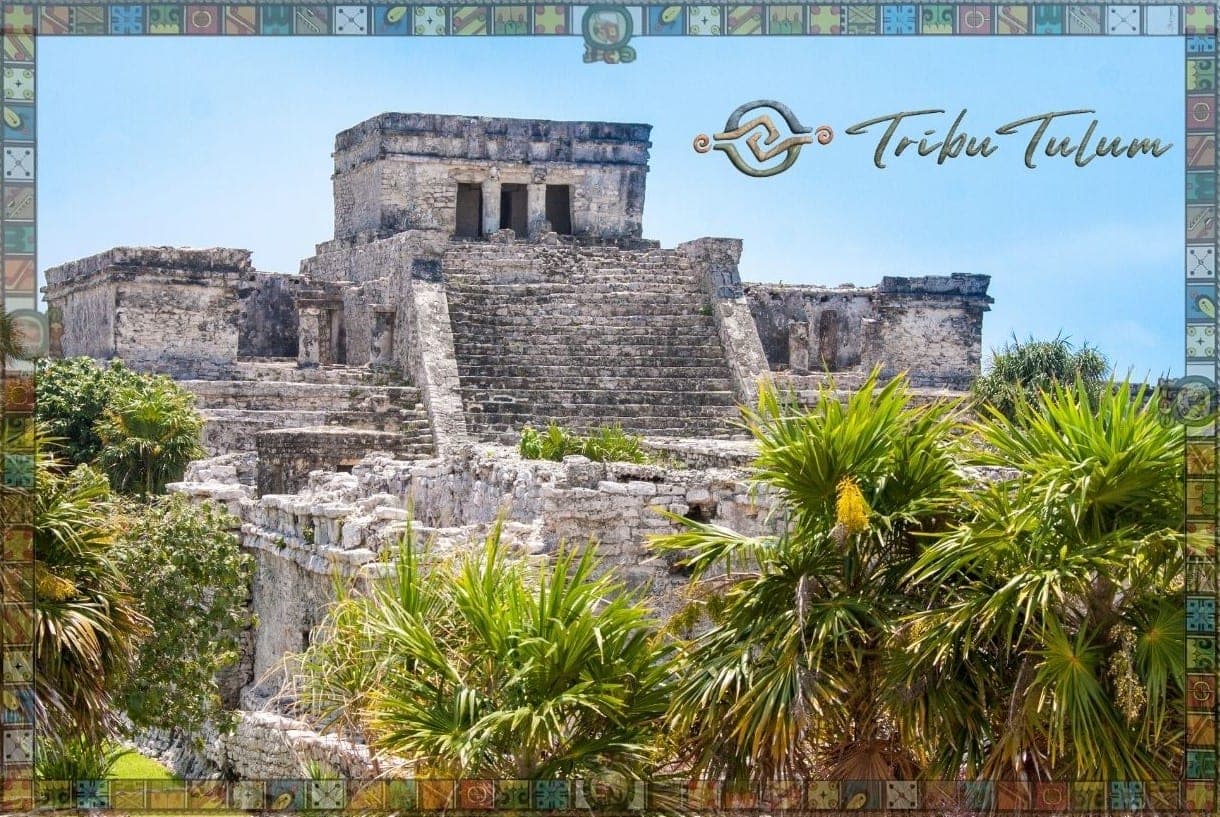
The Tulum Ruins occupy a 12-meter cliff above the Caribbean within a walled enclosure measuring 380 x 170 meters. The site functioned as a Mayan commercial port between 1200 and 1521 AD, controlling maritime trade routes for jade, obsidian, cacao and quetzal feathers between Honduras and the Gulf Coast of Mexico.
Main Structures#
El Castillo (Structure 1) stands 7.5 meters tall and served as a maritime lighthouse: its upper window aligned with the outer reef projected torchlight visible at 5 kilometers to guide commercial canoes. The Temple of the Frescoes (Structure 16) preserves 13th-century polychrome murals depicting Mayan deities such as Itzamna (creator god) and Chaak (rain god), executed in tones of blue, red and black on stucco. The Temple of the Descending God (Structure 5) features a unique sculpture of a winged figure in a descending position, associated with Venus as the evening star or with Ah Muzen Cab, the Mayan god of bees.
Visit Information#
| Detail | Information |
|---|---|
| Hours | 8:00 AM to 5:00 PM, Monday to Sunday |
| Entrance | $90 MXN nationals / $90 MXN foreigners + $55 MXN video |
| Recommended duration | 2-3 hours |
| Best time | 8:00-9:30 AM (before cruise ship passengers) |
| Official guide | $800-$1,200 MXN (1-8 people) |
| Beach access | Stairway from the cliff, swimmable |
| Light rail | $30 MXN from parking lot (800 m) |
Cruise ships from Cozumel and Playa del Carmen deposit 3,000-5,000 tourists daily between 10:00 AM and 2:00 PM. Arriving at 8:00 AM guarantees 90 minutes without crowds. Drone access has been prohibited since 2019 by INAH regulation.
Full site guide at Tulum Ruins: archaeological site guide.
Coba: The Tallest Climbable Mayan Pyramid#
Coba is located 47 kilometers from Tulum (45 minutes by road) and covers an archaeological area of 80 square kilometers, of which only 5% has been excavated. The city reached its peak between 600 and 900 AD with an estimated population of 50,000 inhabitants, making it one of the largest Mayan metropolises of the Classic period.
Nohoch Mul: The Great Pyramid#
Nohoch Mul reaches 42 meters in height with 120 limestone steps, surpassing El Castillo at Chichen Itza (30 meters) and the Pyramid of the Magician at Uxmal (35 meters). From the summit, the view spans 360 degrees of flat jungle to the horizon. The pyramid maintains access for climbing (verify current status, temporary restrictions possible).
The site contains the most extensive known network of sacbeob (white Mayan causeways): 50 elevated limestone roads that connected Coba with cities up to 100 kilometers away. The longest sacbe measures 100 kilometers to Yaxuna, near Chichen Itza.
Rental bicycles ($60 MXN) and pedicabs ($150-$200 MXN per person) facilitate the tour between structures separated by 1-3 kilometers of jungle paths. Entrance: $90 MXN. Hours: 8:00 AM to 5:00 PM.
Detailed guide at Coba: the tallest Mayan pyramid you can climb.
Mayan Culture: Living Traditions and Legacy#
Mayan culture is not merely archaeological heritage. On the Yucatan Peninsula, 800,000 people speak Yucatec Maya as their mother tongue, and communities around Tulum practice ceremonies, cuisine and craftsmanship with roots spanning more than 3,000 years.
Temazcal: Ceremonial Steam Bath#
The temazcal (from the Nahuatl temazcalli, "house of steam") is a purification ceremony that uses volcanic stones heated to 500-700 degrees Celsius, medicinal herbs (rosemary, rue, basil) and chants in the Mayan language inside a domed structure of adobe or stone. Sessions last 1.5 to 3 hours with internal temperatures of 40-70 degrees Celsius. In Tulum, operators offer ceremonial temazcales for $800-$2,000 MXN per person, and tourist temazcales (shorter, less intense) for $500-$1,000 MXN.
Ancestral Mayan Cuisine#
The Mayan cuisine of the peninsula uses techniques predating the Spanish conquest: pib (underground stone oven for cochinita pibil and mukbil pollo tamales), the nixtamalization of corn (an alkaline process that increases the grain's nutritional value by up to 300%), and the use of recado rojo (annatto, pepper, oregano) and recado negro (toasted chiles, spices). Authentic Mayan cuisine restaurants in Tulum town offer menus for $150-$350 MXN per person.
Craftsmanship and Trades#
Mayan crafts from the region include hand-woven hammocks (3-5 day process, price $500-$3,000 MXN depending on size and material), huipil embroidery (ceremonial blouses with floral and animal motifs), Huichol art (originating in Nayarit but present in Tulum with beadwork pieces of 100-10,000 beads on wax), and red cedar wood carving.
Full cultural guide at Mayan culture in Tulum: living traditions and legacy.
Art and Galleries: Murals, Museums and Contemporary Art#
Tulum established itself as a contemporary art hub on the Riviera Maya with the opening of SFER IK Museion in 2018. The art scene spans four categories: immersive museums, contemporary art galleries, street art (murals) and local craftsmanship.
SFER IK Museion#
SFER IK (whose name derives from the Mayan concept of "the flower of life") occupies a structure of 54 organic vaults with no right angles built from bejuco (tropical liana) and cement across 5,000 square meters of jungle. The museum exhibits installations by international artists such as Olafur Eliasson (Firefly, 2022) and Tomas Saraceno. General admission: $400-$600 MXN. Located within the Azulik luxury complex.
Murals and Street Art#
Tulum town features more than 100 murals distributed along the main avenue and surrounding streets, created by local and international artists. Predominant themes: marine fauna, Mayan cosmovision, tropical nature and social commentary. The highest concentration of murals is found between Calle Centauro Sur and Calle Sol Oriente. Free access, 1-2 hour walking tour.
Galleries and Spaces#
The hotel zone concentrates contemporary art galleries with prices from $500 to $50,000 USD per piece. Galleries in town offer local and regional art with prices from $1,000 to $50,000 MXN. Art workshops (ceramics, painting, textiles) cost $500-$1,500 MXN per 2-3 hour session.
Full art scene guide at art and galleries in Tulum.
Shopping and Crafts: Markets and Shops#
Tulum offers shopping across three segments differentiated by zone, price and authenticity.
Where to Shop by Category#
| Zone | Type | Average Price | Authenticity |
|---|---|---|---|
| Town - Craft market | Hammocks, embroidery, souvenirs | $100-$3,000 MXN | High (local artisans) |
| Town - Local shops | Clothing, footwear, local products | $200-$2,000 MXN | Medium-high |
| Hotel Zone - Boutiques | Bohemian fashion, jewelry, decor | $500-$15,000 MXN | Variable |
| Aldea Zama - Concept stores | Mexican design, natural cosmetics | $300-$5,000 MXN | High |
The top products to buy in Tulum: melipona honey (native stingless bee, $200-$400 MXN/250 ml), artisanal chocolate ($100-$300 MXN), henequen or cotton hammocks ($800-$3,000 MXN), artisanal mezcal ($300-$1,500 MXN), and black clay crafts ($200-$2,000 MXN).
Full shopping guide at shopping and crafts in Tulum.
Events and Festivals: Cultural Calendar (2026)#
Tulum maintains an event calendar that combines international festivals, ancestral Mayan celebrations and community events.
Main Events 2026#
| Event | Date | Type | Price |
|---|---|---|---|
| Zamna Festival | Jan-Mar (multiple dates) | Electronic music | $1,500-$5,000 MXN |
| Art With Me | November | Art, music, conferences | $2,000-$8,000 MXN |
| Spring Equinox | March 20 | Mayan ceremony at ruins | Site entrance fee |
| Autumn Equinox | September 22 | Mayan ceremony at ruins | Site entrance fee |
| Day of the Dead | Oct 31 - Nov 2 | Cultural, altars, parade | Free |
| Jazz Festival | December | Live music | Variable |
| Full Moon Parties | Monthly | Dinners, ceremonies, yoga | $500-$3,000 MXN |
The spring equinox at the Tulum Ruins attracts 5,000-8,000 people who observe the play of light and shadow on El Castillo. Zamna Festival operates in multiple jungle and beach venues with international electronic music lineups (Afterlife, Cercle, Keinemusik have presented editions in the region).
Updated calendar at events and festivals in Tulum.
Destination Weddings in Tulum#
Tulum ranks among the top 5 most popular wedding destinations in Mexico with an average of 800 weddings annually. The average cost of a destination wedding in Tulum is $6,200 USD (80-100 guests), with ranges from $3,000 USD (intimate, 20 guests) to $50,000+ USD (luxury, 200+ guests).
Cost Components#
| Item | Price Range |
|---|---|
| Venue (beach club / hotel) | $1,500-$15,000 USD |
| Catering (per person) | $50-$200 USD |
| Wedding planner | $1,500-$5,000 USD |
| Photography + Video | $1,000-$5,000 USD |
| Floral decoration | $500-$3,000 USD |
| Music / DJ | $500-$2,500 USD |
| Legal permits (civil wedding) | $200-$500 USD |
Peak wedding season (November-April) requires venue booking 8-12 months in advance. Low season (May-October) offers 20-40% discounts on venues and vendors.
Full wedding guide at weddings in Tulum: destination wedding guide.
History of Tulum: From Mayan Port to Global Destination#
Tulum (original name: Zama, "dawn" in Maya) functioned as a Mayan commercial port during the Postclassic period (1200-1521 AD). The city controlled maritime routes connecting Honduras with the Gulf Coast, trading jade, obsidian, salt, honey, cacao and quetzal feathers.
Timeline#
| Period | Event |
|---|---|
| 564 AD | First stela with inscription at Tulum |
| 1200-1450 AD | Peak as a Mayan commercial port |
| 1518 | Juan de Grijalva sights Tulum from the sea |
| 1521 | Fall of the Mayan empire to Spanish conquest |
| 1842 | John Lloyd Stephens and Frederick Catherwood document the ruins |
| 1900s | Fishing village with fewer than 100 inhabitants |
| 1970s | First hippie travelers arrive |
| 1981 | Declared a protected archaeological zone by INAH |
| 2000s | Tourism boom, hotel zone construction |
| 2023 | Inauguration of Tulum International Airport |
| 2024 | Tren Maya connects Tulum with Cancun, Merida and Palenque |
Full history at history of Tulum: from Mayan port to global destination.
Cultural Planning: Recommendations#
3-Day Cultural Itinerary#
Day 1: Tulum Ruins (8:00-11:00 AM) + beach below the cliff + town murals (afternoon). Day 2: Excursion to Coba (depart 7:00 AM, return 2:00 PM) + ceremonial temazcal (5:00 PM). Day 3: SFER IK Museion (10:00 AM-1:00 PM) + craft market (afternoon) + Mayan cuisine dinner in town.
Estimated budget for the 3-day cultural itinerary: $2,500-$5,000 MXN per person (entrance fees, transport, activities, excluding accommodation and main meals).
For complete itineraries combining culture with beaches and nature, see itineraries for Tulum: 3, 5 and 7 days. Transport information to all cultural sites at how to get to and around Tulum.