Table of contents
Tulum has over 100 accessible cenotes within a 30 km radius, the highest density of visitable cenotes in the entire Yucatan Peninsula. Cenotes are geological formations exclusive to this region, created by the collapse of Cretaceous limestone over underground rivers that form Mexico's largest aquifer system. The waters maintain a constant temperature of 24-25°C year-round with visibility of 30-60 meters, conditions that make these bodies of water the most sought-after cave diving sites on the planet. The Yucatan Peninsula harbors over 6,000 registered cenotes, of which approximately 2,400 have been explored and 900 are open to the public.
Tulum's natural offerings extend well beyond cenotes. The Sian Ka'an Biosphere Reserve has protected 528,000 hectares of coastal and jungle ecosystems since 1987. Mangrove lagoons, coral reefs of the Mesoamerican Reef System, and low deciduous forest complete a biological corridor with 350+ bird species, 100 mammal species, and 4 sea turtle species that nest on the beaches from May to November.
Cenote Classification: Types and Characteristics#
Cenotes in the Yucatan Peninsula are classified into four categories based on their geological structure. Each type offers distinct swimming, snorkeling, and diving experiences.
Open Cenotes (Open-Air)#
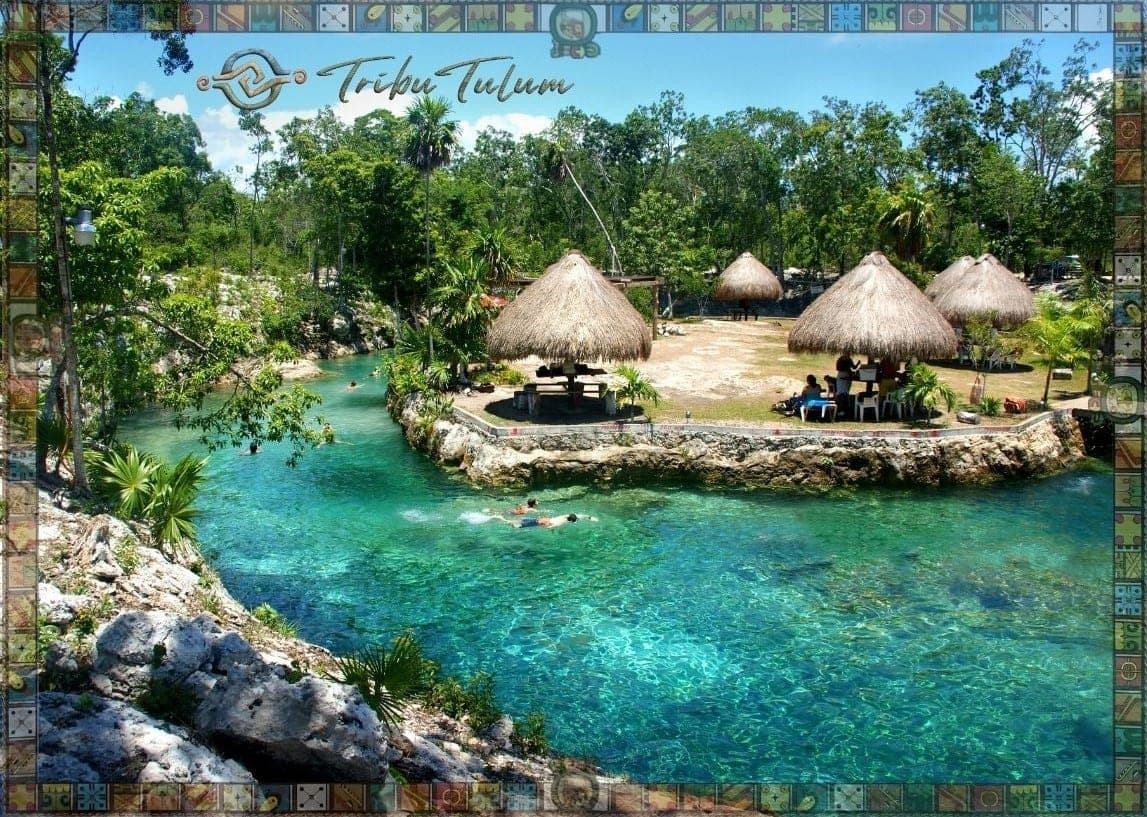
Open cenotes lost their limestone vault through complete collapse, leaving them exposed to direct sunlight. The water displays an intense turquoise color from solar refraction on white limestone bottoms. Depth ranges from 3 to 30 meters. Cenote Azul (km 266 Cancun-Tulum highway) reaches 90 meters in diameter and 3-5 meters deep in family swimming zones. Cenote Cristalino (km 244) operates with jumping platforms at 2, 4, and 6 meters.
Semi-Open Cenotes#
Semi-open cenotes retain part of their rock vault, creating plays of filtered sunlight through the openings. Gran Cenote is the prime example: a partially covered cavern with stalactites and stalagmites illuminated by light beams between 10:00 and 14:00. Cenote Calavera features three circular openings in the vault (two of 1 meter and one of 3 meters in diameter) that serve as jump points into a pool 14 meters deep.
Closed Cenotes (Underground or Cave)#
Closed cenotes maintain their vault intact, requiring access via stairs or vertical descents. Complete darkness demands artificial lighting. The Sac Actun system (expanded Rio Secreto) extends 371 km as the longest underwater cave system in the world. Cenote Suytun (90 minutes from Tulum, near Valladolid) features a column of overhead light illuminating a stone platform at the center of the water, creating one of Mexico's most sought-after photographic phenomena.
Aguada Cenotes (Shallow)#
Aguada cenotes function as shallow depressions (1-3 meters) with dense surrounding vegetation. Historically they served as water sources for Maya communities. They are less common in Tulum's tourist zone.
The 10 Must-Visit Cenotes Near Tulum#
Tulum serves as an ideal base for visiting cenotes due to their geographic concentration. The top 10 cenotes are all within 45 minutes by vehicle.
1. Gran Cenote#
Gran Cenote is located 4.5 km from downtown Tulum on the Tulum-Coba highway. Entry: $500 MXN. Hours: 8:15-16:45. This semi-open cenote combines an open pool with a shallow cave system connected by snorkeling passages. Underwater stalactites reach 2-3 meters in length. Freshwater turtles (Trachemys venusta) permanently inhabit the cenote. Maximum depth is 10 meters. Visitor flow exceeds 1,500 people daily in high season (December-March), with lower attendance before 9:00 and after 15:00.
2. Cenote Dos Ojos#
Cenote Dos Ojos is located 22 km north of Tulum (km 244). Entry: $400 MXN (snorkeling) / $1,600 MXN (diving with equipment). The underwater cave system reaches 82.5 km of explored length, ranked as the third-longest underwater cave system in the world. Dos Ojos offers two main entrances: Eye One (clear waters, stalactites, suitable for snorkeling with vest) and Eye Two (dark cavern with Bat Cave, flashlight required). Visibility exceeds 60 meters. Water temperature is constant at 25°C. The cenote operates as a certified technical cave diving site with depths up to 120 meters in the most remote galleries.
3. Cenote Calavera (Temple of Doom)#
Cenote Calavera sits 2 km from downtown Tulum. Entry: $250 MXN. Three circular openings in the rock vault resemble the eyes and mouth of a skull when viewed from above. The main opening allows a free jump from 5 meters into water 14 meters deep. This closed cenote requires descent by wooden ladder. Maximum depth reaches 17 meters. It is the most popular cenote for overhead photography (shot from above with a swimmer illuminated by the opening).
4. Cenote Zacil-Ha#
Cenote Zacil-Ha is located 3 km from Tulum town. Entry: $150 MXN. An open cenote with graduated depth areas: a children's zone of 0.5-1 meter, a swimming zone of 3-5 meters, and a 3-meter jumping platform. Changing rooms, showers, hammocks, and picnic areas are included with entry. Ideal for families with children under 10 thanks to controlled access conditions. An optional zipline over the cenote costs an additional $100 MXN.
5. Casa Cenote (Cenote Manatee)#
Casa Cenote is located at km 10 of the Tulum-Boca Paila coastal road. Entry: $200 MXN. An open cenote directly connected to the sea through underground channels, creating a mix of fresh and saltwater (visible halocline). Mangrove vegetation surrounds the emerald-colored water. Maximum depth: 8 meters. It is the only cenote in the area where manatees are occasionally spotted (November-March). Ideal for snorkeling, kayaking, and paddleboarding.
6-10. Additional Cenotes#
Cenote Escondido (km 244): open cenote with a 5-meter jumping platform and natural vine swings. Combined entry with Cenote Cristalino: $350 MXN. Cenote Aktun-Ha (Car Wash): open cenote with unique underwater flora (water lilies and aquatic lilies), 14 meters deep, popular for open water diving. Entry: $200 MXN. Cenote Sac Actun: access to the world's longest cave system with a 2-hour guided tour, $700 MXN. Cenote Angelita: advanced diving cenote with a hydrogen sulfide cloud phenomenon ("underwater river" effect) at 30 meters depth, only with a certified operator. Cenote Corazon del Paraiso: semi-open cenote with descent stairs and jumping platform, entry $150 MXN, less crowded than Gran Cenote.
See the detailed guide to the best cenotes near Tulum with photos, access maps, and updated schedules.
Secret Cenotes: Off the Tourist Circuit#
Tulum harbors little-visited cenotes with crystal-clear waters and no crowds. These cenotes operate with minimal infrastructure, managed by local Maya communities that charge between $50 and $200 MXN for entry.
The secret cenotes are located along dirt roads accessible by standard vehicle or bicycle. Maya communities of Punta Laguna, Pac-Chen, and Muyil manage ancestral cenotes with community guides for $300-500 MXN per group. Punta Laguna combines a cenote with a spider monkey reserve (estimated population of 800 individuals) and a zipline over the water.
Discover 8 secret cenotes that few people know about with GPS coordinates and access tips.
Sian Ka'an: UNESCO World Heritage Site#
The Sian Ka'an Biosphere Reserve ("where the sky is born" in Yucatec Maya) spans 528,000 hectares of tropical forest, wetlands, mangroves, and coral reef. UNESCO declared it a World Heritage Site in 1987, making it Mexico's first natural protected area with this designation.
Key Facts About Sian Ka'an#
| Feature | Value |
|---|---|
| Area | 528,000 hectares (5,280 km2) |
| Ecosystems | Tropical forest, mangrove, marsh, reef, coastal dunes |
| Bird species | 350+ |
| Mammal species | 100+ (including jaguar) |
| Fish species | 400+ |
| Sea turtles | 4 species (green, loggerhead, hawksbill, leatherback) |
| Maya channels | 25 km of pre-Hispanic artificial channels |
| Communities | Punta Allen (450 inhabitants, lobster fishing) |
| Annual visitors | 90,000 |
| Entry fee | $58 MXN (natural protected area fee) |
Tours from Tulum operate as full-day excursions (6-8 hours) priced at $1,500-3,500 MXN per person. The typical route includes floating in a freshwater channel (45 minutes), birdwatching from a boat in a mangrove lagoon, and snorkeling on the barrier reef. The fishing community of Punta Allen, 56 km from Tulum via a dirt coastal road (2-3 hours travel time), offers bottlenose dolphin watching with an 80% success rate.
Read the complete Sian Ka'an guide with routes, authorized operators, and wildlife seasons.
Flora and Fauna of Tulum#
Tulum's biodiversity spans interconnected terrestrial, freshwater, and marine ecosystems.
Terrestrial Wildlife#
The jaguar (Panthera onca) inhabits the surrounding jungle with an estimated population of 1,500 individuals in the Yucatan Peninsula, the highest concentration of jaguars in Mexico. Spider monkeys (Ateles geoffroyi) can be seen in the Punta Laguna reserve 20 km from Coba, with a population of 800 individuals. Coatis (Nasua narica) frequently appear at archaeological ruins and cenotes.
Sea Turtles#
Four species of sea turtles nest on Tulum's beaches: green turtle (Chelonia mydas), loggerhead (Caretta caretta), hawksbill (Eretmochelys imbricata), and leatherback (Dermochelys coriacea). Nesting season runs from May to October, with hatching from July to November. Each female deposits between 100 and 180 eggs per nest, with an incubation period of 45-60 days. Conservation programs in the hotel zone protect over 200 nests annually with protection fences and nighttime patrols.
Birds#
The region harbors 350+ bird species, from the keel-billed toucan (Ramphastos sulfuratus) to flamingos (Phoenicopterus ruber) in the Sian Ka'an lagoons (population of 20,000+ individuals). The turquoise-browed motmot (Eumomota superciliosa) is the peninsula's emblematic bird, observable at cenotes and in low forest.
Explore the Tulum flora and fauna guide with wildlife seasons and specialized guides.
Learn about sea turtle season with exact dates, nesting beaches, and release programs.
Conservation and Cenote Etiquette#
Cenotes face environmental pressure from tourism growth. Conservation rules are mandatory at all cenotes in the region.
Fundamental Rules#
- Use only biodegradable sunscreen (oxybenzone and octinoxate free) or avoid sunscreen entirely
- Do not touch stalactites, stalagmites, or rock formations (they grow 1 cm every 100 years)
- Do not feed aquatic wildlife
- Do not use flash in caverns with bats
- Shower before entering the water (showers are available at most cenotes)
- Leave no trash; several cenotes operate a zero-waste policy
Cenotes are freshwater bodies connected to the peninsula's aquifer. Chemical contamination from sunscreen and human waste directly affects the drinking water supply for Maya communities that depend on the underground aquifer.
Read the complete cenote etiquette and conservation guide with detailed protocols and environmental impact data.
Geology and Cosmology: Why Cenotes Only Exist Here#
Cenotes form exclusively in the Yucatan Peninsula due to a unique combination of geological factors. The peninsula's limestone platform was deposited during the Cretaceous period (145-66 million years ago) as a tropical sea floor. The Chicxulub asteroid impact 66 million years ago (180 km diameter crater centered on present-day Chicxulub Puerto) fractured the limestone, accelerating dissolution by slightly acidic rainwater that created the most extensive underground cave and river system on the planet.
For the ancient Maya, cenotes served as entrances to Xibalba (the Maya underworld), sources of sacred water, and ceremonial offering sites. The Sacred Cenote of Chichen Itza (60 meters in diameter, 35 meters deep) revealed offerings of jade, gold, ceramics, and human remains dated between 850 and 1150 AD in 20th-century archaeological excavations.
Dive deeper into cenote geology and the Maya cosmology of cenotes with scientific and historical data.
Plan Your Cenote Visit#
Hours and Prices Summary#
| Cenote | Distance from Tulum | Entry | Hours | Type |
|---|---|---|---|---|
| Gran Cenote | 4.5 km | $500 MXN | 8:15-16:45 | Semi-open |
| Dos Ojos | 22 km | $400 MXN | 8:00-17:00 | Cave |
| Calavera | 2 km | $250 MXN | 8:00-17:00 | Closed |
| Zacil-Ha | 3 km | $150 MXN | 9:00-17:00 | Open |
| Casa Cenote | 10 km (coast) | $200 MXN | 8:00-17:00 | Open |
| Cristalino | 20 km | $350 MXN (combo) | 8:00-17:30 | Open |
| Escondido | 20 km | $350 MXN (combo) | 8:00-17:30 | Open |
| Aktun-Ha | 5 km | $200 MXN | 9:00-17:00 | Open |
Logistics Tips#
The best time to visit cenotes is from 8:00 to 10:00 AM (fewer crowds, better light in semi-open cenotes). Snorkel gear rental costs $100-150 MXN at the entrance of major cenotes. Lockers cost $50-100 MXN. The ideal transport is your own vehicle or bicycle for nearby cenotes (Gran Cenote, Calavera, Zacil-Ha), and taxi or organized tour for distant cenotes (Dos Ojos, Sian Ka'an).
Cenote photography requires specific planning: optimal overhead light occurs between 11:00 and 13:00 at cenotes with upper openings.